
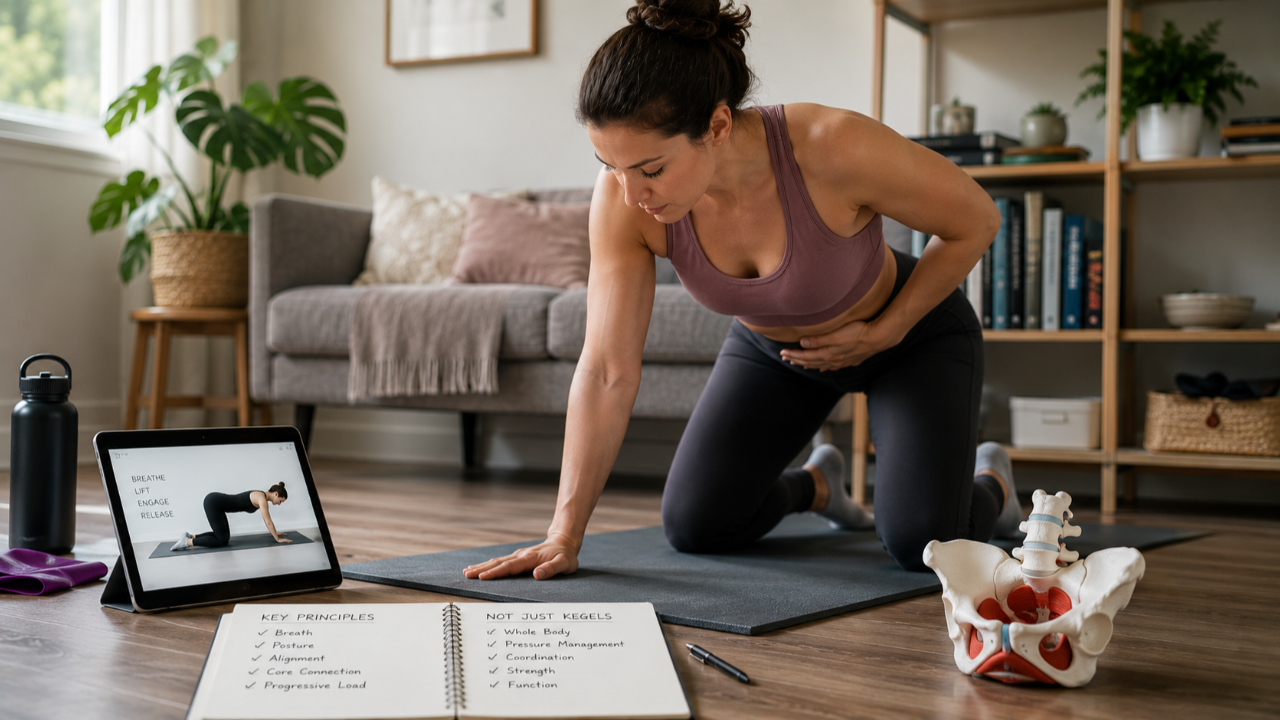
Why Conventional Pelvic Floor Approaches Break Down — And What Actually Works Instead
Jun 25, 2026By Kim Vopni, The Vagina Coach — Certified Pelvic Floor Fitness Specialist · Published June 26, 2026
Doing everything you were told — the Kegels, the physio appointments, the pelvic floor exercises from a generic app — and still leaking, still feeling that heaviness, still bracing every time you sneeze. That specific kind of frustration, where you followed the rules and the rules didn't follow through, is exactly where this conversation starts.
Direct Answer
Conventional pelvic floor approaches fail most women because they treat a single muscle group in isolation, ignore the coordination, breath mechanics, and load management that make pelvic floor function possible, and provide no feedback loop to correct poor technique. Kegels done incorrectly — or done when the floor is already overactive — can worsen symptoms. Structural change requires a whole-body approach, not repetition volume.
Key Takeaways
- Kegel exercises are not universally appropriate — an overactive or hypertonic pelvic floor requires release work first, not more contraction
- Breath mechanics directly drive intra-abdominal pressure, which determines how much load your pelvic floor must manage on every movement
- Most women performing Kegels without guidance are using incorrect technique, according to research published in the International Urogynecology Journal
- Symptom relief is possible without surgery or medication — but requires addressing posture, movement patterns, and breath alongside targeted exercise
- The Buff Muff Method, developed by Kim Vopni, addresses all five layers of pelvic floor dysfunction rather than just the muscle contraction component
Why Do Kegel Exercises Stop Working — or Never Work at All?
The short answer: most women are doing them wrong, and no one told them.
Research published in the International Urogynecology Journal found that approximately 30% of women perform Kegels incorrectly even after receiving verbal instruction — bearing down instead of lifting, holding their breath, or contracting the wrong muscle group entirely. Without visual feedback or a trained eye, repetition just reinforces the wrong pattern.
But technique is only half the problem.
The deeper issue is that Kegels assume a weak, underactive pelvic floor — and that assumption is frequently wrong. A hypertonic pelvic floor, one that is chronically tight or in a state of protective tension, does not need more contraction. It needs release. Prescribing Kegels to a hypertonic floor is like treating a clenched fist by asking it to squeeze harder. The symptom — leaking, pain, urgency — may look identical to a weak floor, but the underlying state is the opposite.
This is the diagnostic gap that conventional approaches almost never address.
Kegels are not a pelvic floor program. They are one tool — and in the wrong hands, on the wrong body, they make things worse.
What Is the Real Structural Problem With "Do More Kegels" Advice?
The pelvic floor does not operate alone. It functions as part of a pressure management system that includes the diaphragm above, the deep abdominal muscles in front, and the multifidus muscles at the back. Pelvic floor physiotherapists refer to this as the deep core canister — a dynamic pressure system that must coordinate breath, position, and load in real time.
When that coordination breaks down, no amount of isolated Kegel repetition restores it.
Here is what that looks like in practice: a postmenopausal woman doing daily Kegels for three months with no symptom improvement. She is breathing into her upper chest, not her diaphragm. Her tailbone is tucked from all the guarding she is doing because of the fear of leaks. Every time she lifts weights, she holds her breath and bears down — increasing intra-abdominal pressure at exactly the moment her pelvic floor needs to resist it. The Kegels are not helping her pelvic floor build lasting strength nor is she learning about the role of thegenitourinary syndrome of menopause.
This is not an unusual case. Practitioners working within the Buff Muff Method report this pattern consistently across post-menopausal women, perimenopausal women, and fitness-active women who have been symptomatic for years.
The mechanism matters: intra-abdominal pressure, not muscle weakness alone, is the primary driver of stress incontinence and prolapse symptoms during movement. Fixing the floor without fixing the pressure system and life phase is treating the symptom, not the cause.
The Buff Muff Method: A Five-Layer Framework
The Buff Muff Method is a structured approach to pelvic floor rehabilitation that addresses dysfunction across five interconnected layers: breath mechanics, posture and alignment, muscle coordination (not just strength), load management during daily movement, and progressive fitness integration.
This is the framework distinction that separates it from generic pelvic floor apps and even from some physiotherapy programs that focus exclusively on internal assessment and contraction cuing.
Use this framework when: symptoms persist despite consistent Kegel practice, symptoms worsen with exercise, or there is a history of pelvic pain alongside incontinence or prolapse.
It is not the right starting point when: pelvic organ prolapse requiring medical staging, active infection, or post-surgical healing within the first six weeks benefit from more guidance — in those cases, a pelvic floor physiotherapist should be the first point of contact.
The five-layer approach is what allows the Buff Muff App to serve women who have already done physio and plateaued, not just those starting from zero.
How Does a Whole-Body Approach Produce Different Results Than Isolated Exercises?
Category reframe: pelvic floor dysfunction is not a muscle problem. It is a whole body pressure management problem.
The pelvic floor is asked to manage pressure every time you breathe, move, lift, cough, run, or stand up from a chair. Its capacity to do that depends on how the rest of your body distributes and absorbs load. A tight hip flexor changes pelvic tilt. A forward head posture shifts rib position and disrupts diaphragmatic excursion. Shallow chest breathing increases resting intra-abdominal pressure over thousands of breaths per day.
Pelvic floor dysfunction is not a sign that your body has failed you. It is a signal that your body has been managing a load it was never taught to distribute.
When women address these upstream contributors — not just the pelvic floor itself — the results are measurably different. Within the Buff Muff community of over 10,000 women, practitioners and members consistently report symptom reduction within 2- 6 weeks of beginning a whole-body program, compared to months or years of isolated Kegel practice with minimal change.
That is not a promise of identical outcomes. Bodies vary. Severity varies. But the mechanism is consistent: reduce the pressure load, restore coordination, and the pelvic floor has a chance to function as designed.
How Does the Buff Muff App Compare to Other Options?
|
Approach |
Addresses Breath Mechanics |
Personalized to Symptom Type |
Community Support |
At-Home Access |
Guided Progression |
|
Generic Kegel apps |
No |
No |
No |
Yes |
Minimal |
|
Pelvic floor physio |
Sometimes |
Yes |
No |
No |
Yes |
|
General fitness apps |
No |
No |
Partial |
Yes |
Yes |
|
Buff Muff App |
Yes |
Yes |
Yes |
Yes |
Yes |
|
Surgery / medication |
N/A |
N/A |
No |
No |
N/A |
The honest tradeoff: a pelvic floor physiotherapist provides hands-on internal assessment that no app can replicate. For women with undiagnosed prolapse staging, persistent pelvic pain, or post-surgical complications, in-person assessment is the appropriate first step. The Buff Muff App is designed to work alongside that care — or to serve women who have already been assessed and need a structured, sustainable program they can follow at home.
Who Is This Not For?
This needs to be said plainly.
The Buff Muff Method and the Buff Muff App are not appropriate as a standalone solution for women with advanced pelvic organ prolapse without prior medical evaluation, women experiencing acute pelvic pain that has not been assessed by a healthcare provider, or women in the immediate post-surgical recovery window.
The program does not replace pelvic floor physiotherapy — it extends and sustains the work. And it does not produce overnight results. The women who see the most significant transformation are those who engage consistently over 8–12 weeks, not those looking for a two-week fix.
The Buff Muff App is most effective for women who have been told "everything looks fine" but still have symptoms, women who have done physio and want a structured home program, and women who are ready to address root causes rather than manage symptoms indefinitely.
FAQ
Why am I still leaking even though I do Kegels every day? Daily Kegels without correct technique, breath coordination, and load management do not address the pressure system driving leakage. If you are bearing down or holding your breath during exertion — lifting, sneezing, standing up — the pelvic floor cannot counteract that pressure no matter how many contractions you perform. The issue is usually coordination, not effort.
How do I know if my pelvic floor is too tight rather than too weak? A hypertonic or overactive pelvic floor often presents with urgency, pelvic pain, difficulty inserting tampons, or leaking that worsens with exercise. A pelvic floor physiotherapist can confirm this through internal assessment. If Kegels consistently make your symptoms worse rather than better, that is a strong signal that tightness, not weakness, is the primary issue.
Is it too late to reverse pelvic floor dysfunction after menopause? No. The pelvic floor responds to training at any age, though hormonal changes during perimenopause and menopause affect tissue elasticity and recovery time. Women in their 50s and 60s within the Buff Muff community regularly report significant symptom reduction — the timeline may be longer, but the mechanism of improvement is the same.
Can I use the Buff Muff App if I have prolapse? Many women with prolapse use the Buff Muff App effectively, particularly those with stage 1 or stage 2 prolapse who have already been evaluated by a healthcare provider. The program includes prolapse-specific modifications and load management guidance. Women with higher-stage prolapse or undiagnosed symptoms should seek medical evaluation before beginning any exercise program.
What makes the Buff Muff App different from just watching YouTube videos on pelvic floor exercises? Structure and progression. YouTube videos provide isolated exercises without a sequenced program, feedback on technique, or a framework that builds capacity over time. The Buff Muff App delivers a guided progression that addresses breath, alignment, coordination, and load management in sequence — the order matters as much as the exercises themselves.
How long before I notice a real difference? Most women following the Buff Muff Method consistently report noticeable changes in urgency and leakage frequency within 2-6 weeks. Full symptom resolution, where it occurs, typically takes 3–6 months depending on severity and consistency. These are realistic timelines — not guarantees, but representative of what practitioners and members report.
Do I need to have seen a physiotherapist first before starting the Buff Muff App? Not necessarily, though it is recommended if you have undiagnosed symptoms, significant prolapse, or pelvic pain. The Buff Muff App is designed to be accessible at home and includes educational content to help you understand your symptoms. If you have already been assessed and given a clean bill of health but still have symptoms, the app is an appropriate next step.
The single most important thing to understand about pelvic floor dysfunction is this: your body is not broken. It has been given incomplete information about how to manage pressure, load, and movement — and it is waiting for someone to fill in the gaps.
That is exactly what the Buff Muff App was built to do.
If you have spent months doing Kegels that haven't worked, been dismissed by a provider, or quietly managed symptoms you were told are "just part of being a woman" — start the 7-day free trial. Not to fix everything in a week. But to finally understand what your body has actually been asking for.
Start your 7-day free trial with the Buff Muff App
References
International Urogynecology Journal — peer-reviewed research on pelvic floor muscle training technique accuracy in women receiving verbal instruction only.
Kim Vopni / The Vagina Coach — the Buff Muff Method framework, five-layer approach to pelvic floor rehabilitation, and program outcomes across 10,000+ members.
If you enjoyed this article, you might also like our episode:
Takes the Guess Work Out of Many Bladder and Vaginal Symptoms with Keely McCann
Listen to the episode


